
FREQUENTLY ASKED QUESTIONS
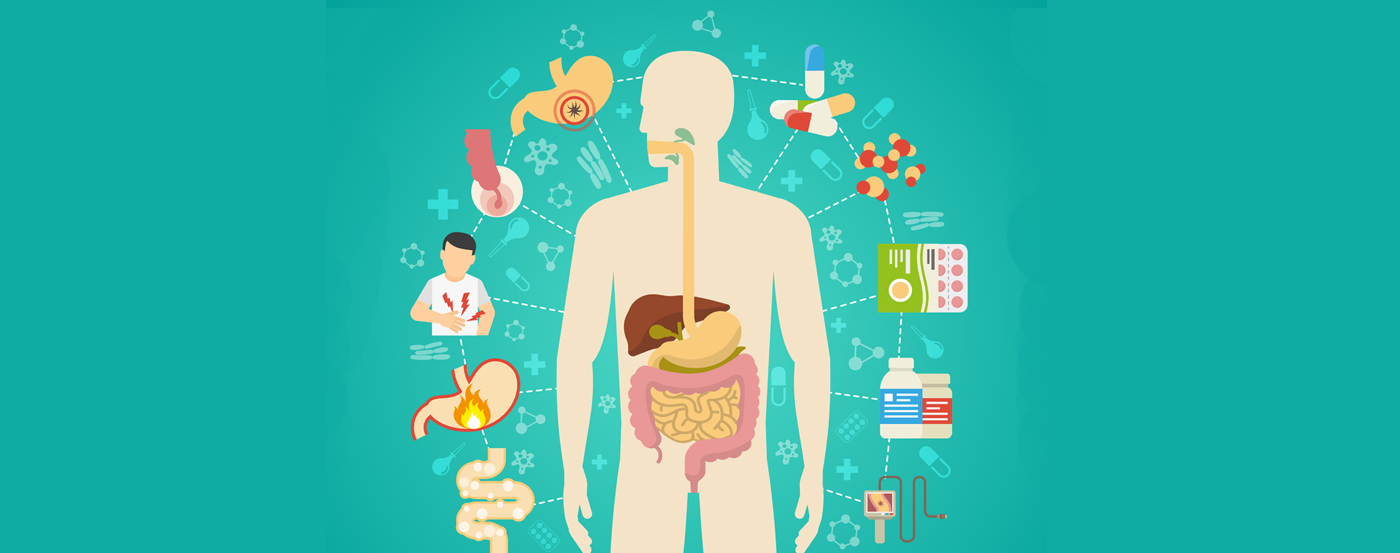
The digestive system is made up of the gastrointestinal (GI) tract, the liver with gall bladder and the bile ducts that connect them, and pancreas. The GI tract is a series of hollow organs consisting of oesophagus (food pipe), stomach, small intestine and colon (large intestine) that includes the rectum, joined in a long, twisting tube from the mouth to the anus. Food enters the mouth and passes to the anus through the hollow organs of the GI tract. The liver and pancreas are the solid organs of the digestive system. The digestive system helps the body digest the food.
Digestion works by moving food through the GI tract. Digestion begins in the mouth with chewing and ends in the small intestine. As food passes through the GI tract, it mixes with digestive juices (comprising bile from liver and pancreatic juice with enzymes), causing large molecules of food to break down into smaller molecules. The body then absorbs these micro molecules through the walls of the small intestine into the bloodstream, which delivers them to the rest of the body. Waste products of digestion pass through the large intestine and anus out of the body as a solid matter called faeces.
- Digestion breaks down food into nutrients, which the body uses for energy, growth, and cell repair.
- Digestion works by moving food through the gastrointestinal (GI) tract.
- Digestion begins in the mouth with chewing and ends in the small intestine.
- As food passes through the GI tract, it mixes with digestive juices, causing large molecules of food to break down into smaller molecules. The body then absorbs these smaller molecules through the walls of the small intestine into the bloodstream, which delivers them to the rest of the body.
The digestive system is made up of the gastrointestinal (GI) tract, the liver with gall bladder and the bile ducts that connect them, and pancreas. The GI tract is a series of hollow organs consisting of oesophagus (food pipe), stomach, small intestine and colon (large intestine) that includes the rectum, joined in a long, twisting tube from the mouth to the anus. Food enters the mouth and passes to the anus through the hollow organs of the GI tract. The liver and pancreas are the solid organs of the digestive system. The digestive system helps the body digest the food.
Digestion works by moving food through the GI tract. Digestion begins in the mouth with chewing and ends in the small intestine. As food passes through the GI tract, it mixes with digestive juices (comprising bile from liver and pancreatic juice with enzymes), causing large molecules of food to break down into smaller molecules. The body then absorbs these micro molecules through the walls of the small intestine into the bloodstream, which delivers them to the rest of the body. Waste products of digestion pass through the large intestine and anus out of the body as a solid matter called faeces.
- Digestion breaks down food into nutrients, which the body uses for energy, growth, and cell repair.
- Digestion works by moving food through the gastrointestinal (GI) tract.
- Digestion begins in the mouth with chewing and ends in the small intestine.
- As food passes through the GI tract, it mixes with digestive juices, causing large molecules of food to break down into smaller molecules. The body then absorbs these smaller molecules through the walls of the small intestine into the bloodstream, which delivers them to the rest of the body.